- Content
- Format
- Source
We tested everything from $286 tailgate pads to $1,000-plus hitch racks—here are the ones worth your money.(Photo: Matt Beers)
Table of Contents
Overview: The best bike rack depends on your vehicle, bike type, and budget. Hitch-mounted tray racks are the most popular option for ease of use and versatility, while vertical racks excel at hauling multiple bikes. Roof racks keep your rear clear but require more effort to load. For e-bikes, prioritize weight capacity. Pinkbike’s editors tested eight racks across real road trips to find the best option for every type of rider.
For most riders, the journey to the trailhead is where every ride actually begins—and having the right bike rack makes all the difference between a hassle and a seamless, worry-free experience. Whether you’re hauling heavye-bikes, loading up for a shuttle day with friends, or bringing bikes along on afamily camping trip, a well-designed rack should be simple to install, easy to use, and above all, capable of securing your cargo safely.
To find the best bike racks on the market, we partnered with the experts atPinkbike, whose editors see and use the full spectrum of bike-hauling solutions in their day-to-day lives. In this roundup, we cover the best options available, prioritizing ease of use in real-world conditions—including cross-country road trips in both summer and winter. From hitch racks to tailgate pads, here are the best bike racks for every type of rider.
Updated June 2026: We rebuilt this guide from the ground up, adding new and updated models alongside our top budget-friendly roof and trunk rack picks—because not every rider needs a $1,600 hitch rack.
Best Bike Racks: At a Glance
• Best Overall:Kuat Piston Pro X ($1,589) • Best Off-Roading Rack:1UP Super Duty ($675) • Best Budget Hitch Rack:Hollywood Racks Trail Rider ($300) • Best Trunk Bike Rack:Saris Bones EX 3 ($260) • Best Vertical Rack:Thule ReVert 6 ($1,300) • Best Roof Rack:Thule Upride ($400) • Best for Heavy E-Bikes:VelociRAX RAXzilla ($1,199) • Best Tailgate Pad:Race Face T3 ($286) • Best Swing-Away Rack Adapter:1UP RakAttach ($649)
Best Overall
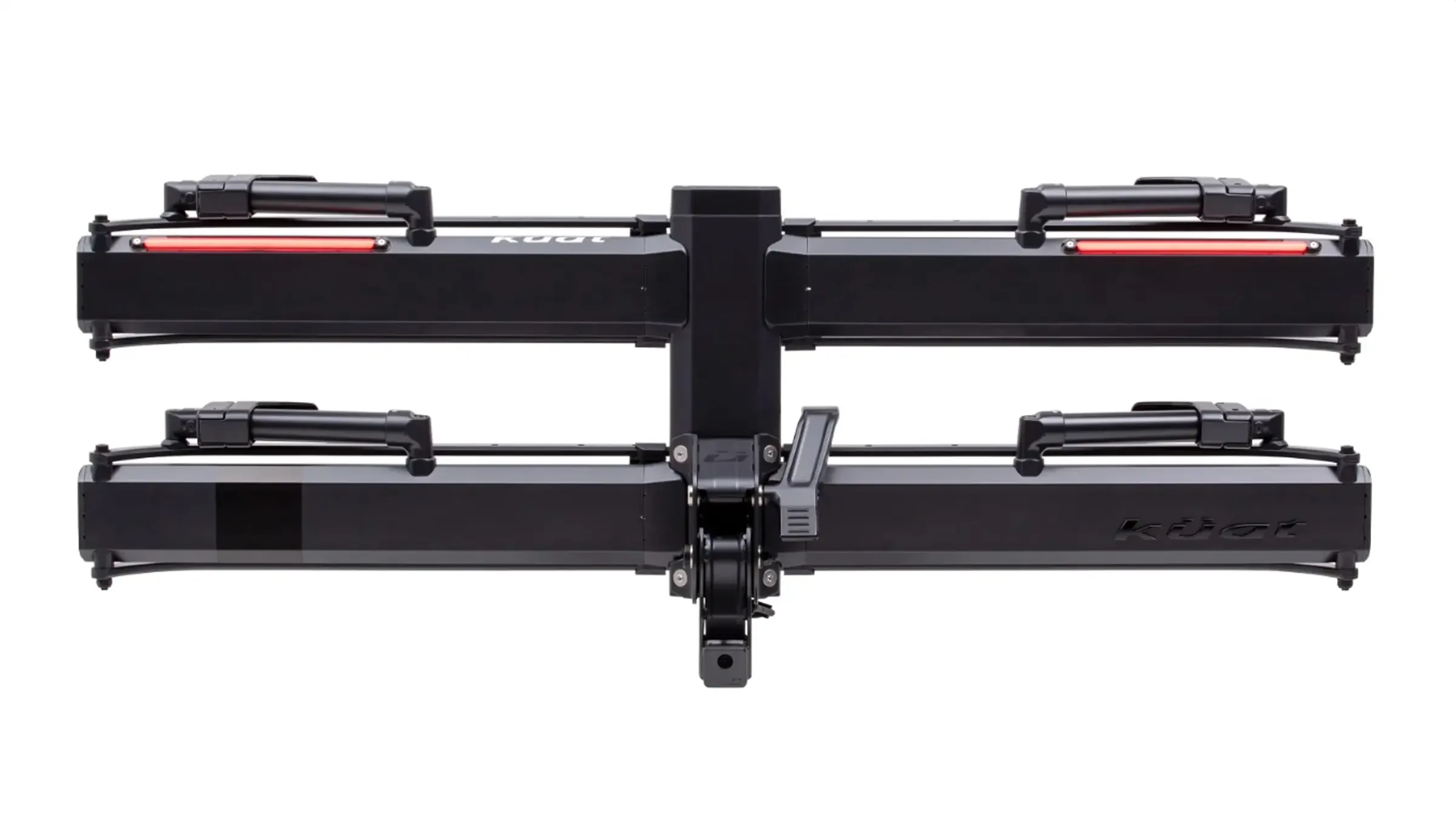
Küat Piston Pro X
Weight Limit:67 lbs per trayCapacity:2 bikes (add-ons available for up to 4)Wheel Diameter Range:18–32 in.Max Tire Width:5 in.Rack Weight:64 lbs
Pros and Cons+ No frame contact+ Air-assisted OneTap arms+ Integrated brake lights– Expensive– Heavy
An updated version of our previous top pick, the Piston Pro X builds off the legendary performance of its predecessor. This no-expense-spared rack features every premium detail and finish you could ask for, packed into an ultra-dialled—and, unfortunately, expensive—package. The price tag is exorbitant, no question, but anyone after the ultimate in ease of use, safety, and long-term durability need look no further.
The dual-arm, touchless design makes loading and unloading a simple OneTap process—a quick flick of a button and the arms open automatically. Genuine Kashima coating, the same ultra-slick finish found on top-of-the-line FOX suspension forks, covers the struts to ensure smooth operation for years to come. The rack easily accommodates wheel sizes ranging from 18-inch kids’ bikes up to 32-inch wheels, and tire widths up to 5 inches.
Rounding out the feature set: integrated brake lights that plug directly into your vehicle, a patented Flatlock Hitch cam that eliminates sway, and a semi-integrated 12mm
cable lock. Add a hefty 67-pound per-tray weight capacity and availability in 2-, 3-, and 4-bike variants, and the Piston Pro X is the ultimate hauling rig for any mountain biker.
Best Off-Roading Rack
1UP Super Duty
Weight Limit:100 lbs per trayCapacity:2 bikes (add-on trays available for up to 4)Wheel Diameter Range:16–32 in.Max Tire Width:5 in.Rack Weight:37 lbs (single tray)
Pros and Cons+ Virtually indestructible+ Stackable for up to 4 bikes+ Great off-road stability+ USA-made– Heavier than aluminum rivals– Expensive– Trickier to load than Piston Pro X
The 1UP Super Duty is the rack mountain bikers reach for when trails get really rough. Its all-steel, American-made construction shrugs off the abuse that would rattle lesser racks loose, and a major refresh added one-handed loading and an adjustable wheelbase, making it more versatile than ever. It handles tires up to 5 inches wide and can be stacked with additional trays to carry up to four bikes.
Compared to competitors like the Piston Pro X, the Super Duty opts for a more utilitarian construction, skipping features like automatically opening arms and integrated tail lights. The 1UP approach centers on simplicity and robustness: everything you need to get the job done, nothing you don’t. Its burly clamping mechanism and overall construction ensure a sturdy grasp on that precious cargo, no matter what the road throws at you. Combine that with extensive after-sales support and a plethora of replaceable parts, and the 1UP Super Duty proves it is not only tough but built to last a lifetime.
A 100-pound tray capacity will haul even the heaviest e-bikes, though our testers found the tilt feature tricky to engage when fully loaded. The 1UP EZ Pull handle accessory ($99) alleviates this—arguably it should come standard, but for riders who plan to keep the rack loaded, we highly recommend adding it. For those looking for an even burlier setup, 1UP also makes the new Xtreme Duty—a beefed-up version worth a mention for anyone who demands the absolute maximum in off-road capability.
Best Budget Hitch Rack
Hollywood Racks Trail Rider Hitch Bike Rack
Weight Limit:45 lbs per trayCapacity:2 bikesWheel Diameter Range:20–29 in.Max Tire Width:3 in.Rack Weight:37 lbs
Pros and Cons+ Excellent value+ Easy to use+ Tilts for trunk access– Lower weight limit– Won’t fit all frames– Mounting style can risk frame contact
Hollywood Racks is known for its value-oriented offerings, providing customers with good quality at prices that are typically much lower than the big guys. The Trail Rider is no exception, having previously taken top honors as our best value pick. Although Hollywood offers a similar rack for less ($349), the Trail Rider’s added 10-pound capacity is worth the extra cost: even burly enduro or DH bikes come in under the 45-pound limit. A tilting trunk-access feature is pretty unheard of at this price point.
The rack does come with concessions compared to more premium options. The biggest issue is the top-down hook, which puts pressure on the bike’s frame and could cause damage over rough roads. It also won’t fit all frames—low-slung top-tube designs won’t be tall enough to connect with the hook. Hollywood makes an aftermarket adapter for this, but at this price point, some compromise is par for the course. Beyond that, there’s no better bang for the buck on the market to get you started and out hitting the trails.
Best Trunk Bike Rack
Saris Bones EX 3-Bike
Weight Limit:35 lbs per cradleCapacity:3 bikesRack Weight:9 lbs
Pros and Cons+ No hitch required+ Very lightweight+ Fits almost any car+ Anti-sway cradles– Less secure than hitch racks– Limited to smaller tires– Not for e-bikes
No hitch? No problem. There are plenty of options on the market to get your bikes stowed and carried, even if your vehicle doesn’t have a trusty hitch receiver installed. One option stands above the rest year after year: the Saris Bones 3. Although originally released back in 1996, a tried-and-true track record, minimal revisions over the decades, and an approachable price point keep this rack at the very top of the list for trunk-mounted solutions.
At an incredibly light 9 pounds, the Bones is lightweight and easy to store when not in use. Its unique injection-moulded, arc-shaped design allows it to fit a remarkably wide range of vehicles, even many hatchbacks and sedans with factory spoilers. It utilizes ratcheting straps to securely fasten bike frames of various shapes and sizes, and features built-in anti-sway straps to keep bike-to-bike contact to a minimum. Admittedly, like all trunk-mounted racks, it is inherently less secure against theft than a locked hitch rack and requires a bit more care during loading. However, the Bones remains the most effective, paint-friendly, and budget-conscious performer in this category. For riders looking for a simple, tool-free solution that fits almost any car, look no further.
Best Vertical Rack
Thule ReVert 6
Weight Limit:55 lbs per cradle (250 lbs total)Capacity:6 bikesWheel Diameter Range:24–29 in.Max Tire Width:3–5 in. (fat-bike wheel baskets sold separately)Rack Weight:87.4 lbs
Pros and Cons+ Holds up to 6 bikes+ TiltAssist hydraulic damper+ RV travel certified+ Tool-free AutoAttach anti-wobble– Expensive– Heavy to install– Lower weight limit than some platform racks
For hauling a crowd to the trailhead, Thule’s ReVert stands out as a best-in-class vertical rack for overall construction, ease of use, and premium features. Bikes hang vertically and roll easily into wheel baskets that grab only the front tire, while durable rubber straps cinch down the rear wheels—meaning zero contact with your bike’s frame, fork, or components.
The standout feature is the ReVert’s dual TiltAssist Damper system. A quick pull of a lever actuates a hydraulic damper to safely lower the rack for hassle-free bike loading or trunk access — and once your fleet is loaded, that same gas strut helps lift the heavy rack back into place with minimal effort. Generous 12-inch spacing between the wheel baskets provides plenty of room to maneuver without the risk of bars and brake levers clashing.
Admittedly, the rack is on the heavier side at 87 pounds, so it’s smart to enlist a buddy for initial installation. Thule mitigates this with their tool-free AutoAttach system, which locks into your 2-inch receiver and automatically expands to eliminate hitch wobble. A plethora of clever accessories round out the package—fat-bike wheel baskets, integrated cable locks, and even a built-in bike repair stand. A 55-pound per-tray weight capacity handles most e-bikes on the market comfortably, making the ReVert one of the most dialled and user-friendly ways to haul your entire crew.
Paid Advertisement by Backcountry.com
Thule Verse 2-Bike Hitch Rack + Repair Holder
When you’re bringing your bike along on your more rugged and remote adventures, you want to be sure that your hitch can get it there securely and safely. You also want to be able to make repairs and tuneups even while you’re on the go. Enter the Thule Verse 2 Hitch Rack and Repair Holder. This rack supports two bikes up to 55 pounds each, meaning it can handle even the heaviest gravel setups and e-bikes. And the best part: it comes equipped with the Verse Repair Holder that attaches to the rack’s outer arm, so you can make tuneups and repairs with ease. Transitioning from travel to trail has never been easier.
Best Roof Rack
Thule Upride
Weight Limit:44 lbs per trayCapacity:Depends on roof setupWheel Diameter Range:20–29 in.Max Tire Width:3 in. (5 in. with fat-bike adapter, sold separately)Rack Weight:17 lbs
Pros and Cons+ No frame contact+ Integrated locking system+ Lightweight– Max 29 in. wheel out of box– Difficult to load on taller vehicles– Not rated for heavy e-bikes
For riders who prefer to keep their bikes on the roof rather than hanging off the bumper, the Thule UpRide is a premium, versatile choice. The major selling point is its clever dual-hoop front wheel design, which provides a rock-solid hold without ever touching your bike’s frame. A ratcheting rear tire strap completes the system, and at a lightweight 17 pounds per tray with an easy mounting system, you can effortlessly install, configure, or remove them as needed. Security is neatly integrated (as you’d expect from Thule), with a built-in cable that locks the bike to the rack, and a second system that locks the rack itself to your vehicle’s crossbars.
The loading mechanism is a bit confusing at first, but becomes second nature after a few tries. The main bar folds forward and locks into position; slide the bike in, then push the second bar up until it clicks and ratchets tight against the front wheel. Out of the box, it accommodates 20- to 29-inch wheels and tire widths up to 3 inches, though fat-bike riders can grab an adapter to stretch that out to a full 5 inches.
Keep in mind that at a 44-pound maximum weight capacity, the UpRide is strictly meant for standard mountain bikes and is not rated for heavy e-bikes. You’ll also want to make sure you have the shoulder strength to hoist your bike up to roof level after an exhausting ride. But if you want a sleek, aerodynamic rooftop setup that protects your paint and handles odd frame geometry with ease, the UpRide is tough to beat.
Best for Heavy E-Bikes / Other Two-Wheeled Vehicles
VelociRAX RAXzilla
Weight Limit:275 lbs (straps required over 90 lbs)Capacity:1-2 bikeWheel Diameter Range:24–29 in.Max Tire Width:5 in.Rack Weight:73 lbs
Pros and Cons+ Unmatched 275 lb payload+ Integrated retractable loading ramp+ Auto-clamping front tire system+ 3 tilt positions for trunk access– Very heavy rack (73 lbs)– Requires Class III hitch with 500 lb tongue rating– Expensive
With a name like RAXzilla, you know the designers meant business. No rack on the market matches the VelociRAX RAXzilla’s massive 275-pound payload capacity—it’s engineered specifically to be the easiest-loading, heavy-duty rack around, with the muscle to carry everything from a lightweight road bike to a full-blown dirt bike or heavy electric moto.
The rack features a slick, auto-clamping front tire system that locks your wheel into place without tools, and an integrated, retractable tray that tilts all the way down to act as a built-in loading ramp. This turns loading a heavy e-bike or dual-sport motorcycle into an easy solo effort—a full loading procedure literally takes less than ten seconds. Three tilt positions allow you to drop the rack out of the way for quick trunk access without needing to unload your machine first.
It’s an absolute monstrosity of a hitch rack, but it is impressively well-thought-out. True to the VelociRAX pedigree, it comes equipped with a rock-solid anti-rattle system that can be tightened down via a wrench to keep the rack completely stable and wobble-free, even on the roughest backcountry roads. For those looking for the most effortless loading experience of any two-wheeled vehicle, no matter the weight, the RAXzilla is it.
Best Tailgate Pad
Race Face T3
Capacity:5 bikes (mid-size), up to 6 bikes (full-size)Rack Weight:5.5 lbs
Pros and Cons+ Allows tonneau covers to fully close+ Secure individual fork pockets+ Quick on/off install+ Keeps bikes separated– Truck only– No locking– Bikes exposed to weather– Bed access blocked
Tailgate pads are the ultimate in simple, dependable bike storage—possibly the original solution, and still the simplest. The Race Face T3 is the modern evolution of the classic pad, built with a robust core and packed with well-thought-out features that elevate it well beyond “just a pad.”
Feature-wise, the T3 is loaded. Ridged, compression-moulded fork pockets keep bikes neatly separated and upright, while secure downtube straps prevent side-to-side movement—and can be fine-tuned across numerous mounting positions to work with whatever else you’re hauling. It fits most full-size and mid-size trucks and installs in under a minute: no hitch, no hardware, no worries. A Velcro window gives clear access to your tailgate handle, and the thick downtube padding folds away so you can still close and lock a folding tonneau cover without removing the pad entirely.
There are a few options to choose from, including a partial-coverage Half-Stack two-bike version, as well as full-size (up to six bikes) and mid-size (up to five bikes) configurations. All are constructed from a heavy-duty PVC tarpaulin and feature a micro-brushed inner lining to protect your truck’s paint. Of course, all these premium features come at a cost, with the full-size T3 coming in at $286. It’s not cheap, but for riders after shuttling convenience and security, it delivers.
Best Swing-Away Rack Adapter
1UP RakAttach
Weight Limit:275 lbsRack Weight:56 lbs
Pros and Cons+ Universal 2-in. hitch compatibility+ 275 lb rating+ APS accessory system+ Easy trunk access (swings 100 degrees)– Adds length behind vehicle– Not a standalone rack– Higher cost for an adapter
Swing-away systems are the best way to get the most out of your hitch setup, ensuring full trunk or truck bed access even when your bike rack is completely loaded down. Pull a lever, and the entire assembly pivots out of the way. It’s perfect for camping, overlanding, or setting up a cooking station for a post-ride tailgate session.
The 1UP RakAttach is one of the most dialled solutions on the market, turning any standard hitch rack into a swing-away system while extending it out for extra vehicle clearance. The unit swings open a full 100 degrees and can be ordered in either a driver- or passenger-side configuration. Its burly, powder-coated steel construction allows for up to 275 pounds of total weight capacity—easily supporting a heavy 4-bike rack—and an included anti-wobble bracket clamps everything down tight for rattle-free travel over rough terrain. 1UP’s new Accessory Panel System (APS) lets you bolt rugged MOLLE panels right onto the arm, creating mounting points for a fold-up camp table, traction boards, or fuel cans, turning the dead space behind your rack into highly functional cargo real estate.
It’s admittedly a heavy and pricey addition to your hauling setup, but it is well worth the investment if you spend a lot of time travelling, camping, and posting up on long-distance riding trips.
Bike Rack Comparison Chart
How To Choose a Bike Rack
When choosing a bike rack, consider your vehicle type, bike weight, and the number of bikes you need to carry. For instance, if you’re carrying one or more e-bikes, you’ll need to ensure your rack and hitch accommodate higher weight requirements. Also, consider how frequently you plan to carry bikes. If you plan to use it multiple times a week, investing in a top-quality hitch rack will pay off. If you only plan to use a rack several times a year, a more budget-friendly option, like a trunk rack, might be a suitable option.
Hitch Racks vs Trunk Racks vs Tailgate Pads
Hitch racks are the most secure and convenient, but require a receiver hitch. (We strongly recommend using a Class III 20-inch receiver whenever possible, as it has a higher weight limit and provides significantly more stability than 1 ¼-inch models.) Trunk racks offer affordability and the versatility to mount them on vehicles without trailer hitches, but they require more setup and generally don’t carry bikes as securely as platform-style hitch racks. Tailgate pads work best for truck owners transporting multiple mountain bikes.
Frequently Asked Questions
How do you load bikes onto a bike rack?
Loading depends heavily on the style of rack, but the basic strategy is always the same. First, prep the rack by opening all the mounting mechanisms—whether that means flipping open tire bars, pulling out wheel trays, or unlatching straps. You don’t want to be fighting a closed mechanism while balancing a bike midair. Carefully hoist the bike into place, avoiding contact between the frame and any metal structure. Once the wheels or frame are resting in their cradles, tighten all straps or clamps securely. Give the bike a firm shake to confirm it’s locked down, and you’re ready to rock.
What is the best bike rack for mountain bikers?
Modern mountain bikes are expensive, often feature complex frame geometries, and are frequently made of lightweight carbon fiber that shouldn’t be subjected to rubbing or banging. If you’re serious about protecting your investment, we highly recommend a tray-style or vertical rack that connects only to the tires, completely avoiding frame contact. This is the safest and most secure way to haul a mountain bike. Premium options like the Kuat Piston Pro X or the Thule ReVert are excellent places to start, though plenty of similar options exist at lower price points.
What is the best bike rack for e-bikes?
Electric bikes present a unique challenge purely due to their weight. To keep things simple and save your spinal cord, a hitch-mounted platform or heavy-duty vertical rack is almost always the best route; hoisting a 50-plus-pound e-bike onto a roof rack is a recipe for a bad time. Racks like the1UP Super Duty,Kuat Piston Pro, andVelociRAX RAXzillaare all top-tier choices engineered to handle heavy payloads. Better yet, many premium racks in this space now offer optional or integrated loading ramps, allowing you to simply roll the bike right onto the tray without any heavy lifting, a feature that will save your back tenfold over time.
Electric bikes present a unique challenge purely due to their weight. A hitch-mounted platform or heavy-duty vertical rack is almost always the best route—hoisting a 50-plus-pound e-bike onto a roof rack is a recipe for a bad time. Racks like the 1UP Super Duty, Kuat Piston Pro X, and VelociRAX RAXzilla are all top-tier choices engineered to handle heavy payloads. Better yet, many premium racks now offer optional or integrated loading ramps, letting you roll the bike right onto the tray without any heavy lifting—a feature that will save your back tenfold over time.
Are hitch-mounted bike racks better than roof racks?
Not necessarily—every hauling system comes with its own set of pros and cons. Hitch racks are incredibly popular because they sit much lower to the ground, making them vastly easier to load, especially with heavy rigs. Roof racks, on the other hand, are a fantastic option if you don’t have a hitch on your vehicle, want to keep your rear view clear, need frequent trunk access without moving a heavy rack, or regularly tow a camper or trailer. That said, for the vast majority of riders, hitch-mounted racks remain the most user-friendly and convenient option.
How We Test Bike Racks
We tested these racks on eight different types of vehicles, including trucks, hatchbacks, SUVs, and vans. Our goal was to evaluate them based on ease of use, security, and durability. We assessed each rack in our test in real-world conditions that included quick after-work rides as well as multi-state trips to our favourite riding destinations in British Columbia, Colorado, Utah, Washington, Oregon, and Arkansas. While we logged more than a thousand highway miles, we also spent time on unpaved forest roads to gauge which racks would really limit sway (and hold up to abuse).
We also tested the weather resistance of each rack by leaving them on vehicles during winter driving conditions. We took note of the time it took to assemble each rack, as well as installation and load times. During testing, we noted any issues with bike stability, usability, and degradation in performance due to wear and tear.
Meet Our Testers
Josh Pattersonhas been riding and wrenching on bikes for 20 years and, with a master’s degree in journalism, has been writing about the sport for more than half of that time. He’s a cycling generalist who finds joy in riding road, gravel, and mountain bikes.
Samantha Boonhas turned wrenches in bike shops, worked in trail advocacy, and written for several cycling media titles. She’s an avid rider and professional communicator who is able to convey the features and benefits of the products she tests in an approachable manner.
Stephane Pelletier,based in Cumberland, BC, is Pinkbike’s content manager, overseeing events, tech, media, and gear reviews. He got his start in bike shops at age 14 and competed in slopestyle before taking on brand marketing roles within the bike industry. With 18 years of experience and an unrelated geology degree from the University of Calgary, he pairs deep tech knowledge with a passion for the sport. Off the clock, he’s usually riding, surfing, snowboarding, or on his motorcycle.
Robbie Jacksondoesn’t just ride bikes; he also builds them. In addition to being a fabricator, Jackson enjoys off-roading and overlanding, making him the perfect candidate to stress-test bike racks on the back of his Ford Raptor.